Wednesday, November 15, 2017

The Jewish Spies Who Helped the British Defeat the Ottoman Empire in World War I


The Jewish Spies Who Helped the British Defeat the Ottoman Empire in World War I

The achievements and sacrifice of a family of Palestinian Jews helped to secure both victory in war and Great Britain’s endorsement of Zionism.
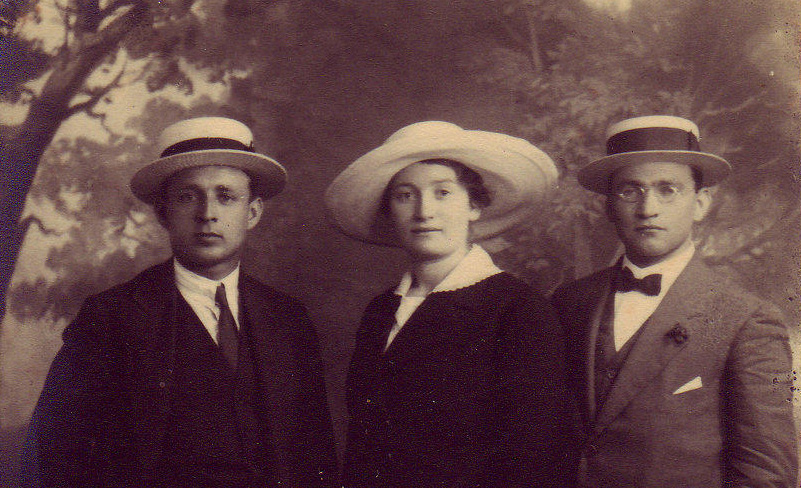
Yosef Lishansky, Sarah Aaronsohn, and Lyova Shneerson, three members of the NILI spy ring, in Cairo, 1917. Beit Aaronsohn-Museum Nili, Zikhron Yaakov.

Yosef Lishansky, Sarah Aaronsohn, and Lyova Shneerson, three members of the NILI spy ring, in Cairo, 1917. Beit Aaronsohn-Museum Nili, Zikhron Yaakov.
One-hundred years ago this month, the Ottoman Turks, then in control of Palestine, rounded up and destroyed a Zionist intelligence network that made a decisively important contribution to the British invasion and liberation of Palestine. This is the group’s story.
The Great War of 1914-18—now called World War I—ended the Ottoman empire’s control of the Near East and allowed both Zionism and Arab nationalism to advance. After Britain invaded Palestine in 1917, its officials would run it for three decades and relinquish it only under pressure. Because they exerted themselves to hold on to the Holy Land, one might suppose they had jumped at the opportunity to conquer it.
In fact, they hadn’t.
The government of Prime Minister Herbert Henry Asquith, which took Britain into the Great War, had little to no interest in Palestine. It focused chiefly on Europe’s Western front and, in line with liberal principles, opposed enlarging the British empire at all. Even after the Ottoman empire joined with the Central Powers and became an enemy, Asquith’s War Office begrudged resources for efforts against the Turks. It planned to defend Britain’s control of Egypt but to let others fight in the Near East, which top British generals deprecated as a sideshow.
But bad war news—the Gallipoli defeat, exasperating stalemate on the Western front and astounding casualties at the Somme and elsewhere—toppled the Asquith government. In December 1916, David Lloyd George replaced Asquith as prime minister and changed the Allied war strategy. For him, routing the Turks was the key to victory. His war cabinet ordered the invasion of Palestine and on November 2, 1917 issued the Balfour Declaration.
That official endorsement of Zionism ignited a firestorm of controversy that hasn’t subsided for a century. Debated intensely at the time, it still elicits angry denunciations, most vocally in this anniversary year by Palestinian Arab officials. Making sense of it requires understanding why British leaders, fighting for the life of their empire in the Great War, did what they did.
When they promised to support a national home in Palestine for the Jewish people, British leaders were not thinking narrowly about Palestine and only Palestine. Their strategic perspective took in the entire postwar Middle East (which itself was but one of many regions demanding British attention). They also envisioned dealing generously with the Arab people, who would be put on the path to national self-determination in several large countries. Indeed, even though most Arabs had aligned themselves with the Allies’ Turkish enemies, they would get control of almost all the land they claimed. The Arabs in Syria, Iraq, Arabia, and elsewhere would emerge from the war far better off than some of the peoples of Europe, especially those on the losing side.
True, the Arabs in Palestine would eventually live as a minority in a democratic, Jewish-majority country, and that was an imposition—but, as Lloyd George saw it, a relatively minor one. During World War I, no one thought of the Arabs in Palestine as a distinct people entitled to national self-determination on their own—not even the Palestinian Arabs themselves. Anti-Zionists today say that the Arabs’ relegation to minority status was a unique collective misfortune, but the British authors of the Balfour Declaration knew it wasn’t. They were committed to protecting the individual rights of the Arab minority in Palestine just as they intended to do for minority peoples in newly delineated states throughout Europe.
Lloyd George’s embrace of Zionism reflected a moral impulse to succor the Jews after centuries of mistreatment. It was also strategic, part of a worldwide effort to win public opinion over to Britain’s side in the war. Since the war’s outbreak, many Jews had sympathized with the Central Powers because Russia, the world’s most anti-Jewish country at the time, was one of the Allies. Lloyd George saw it as a wartime necessity to give Jews everywhere, and especially in Russia and America, an interest in Allied victory. In addition, serving as the Zionists’ protector would help Britain to justify retaining control over Palestine as part of the postwar peace arrangements.
Those were the outlines of the bigger picture—why the Balfour Declaration fitted into British strategy. There are also noteworthy smaller pictures: in particular, how British policy makers learned about Zionism from Jews who contributed courageously and valuably to the Allied war effort.
The story of Aaron Aaronsohn and his NILI spy network is a significant, if generally underappreciated, part of the history of the Great War and the Middle East.

In the summerof 1917, Lloyd George had ample motive to press for a fast, morale-boosting victory. The Allied war against the German, Austro-Hungarian, and Ottoman empires was continuing to produce enormous losses with little hope of a breakthrough on the Western front. The British war cabinet, considering opportunities in the Near East, debated whether to make a pro-Zionist statement. General Edmund Allenby had just been given command of British forces in Egypt. In June, meeting him for the first time, Lloyd George exhorted the general to deliver “Jerusalem by Christmas.”
Allenby considered invading Palestine by marching his forces from Egypt, up the coast, through Gaza. He faced the same problems that had stymied his predecessor, Sir Archibald Murray: water for his troops, and Gaza’s daunting fortifications. His initial plans received poor reviews from the Imperial General Staff, whose chief remained opposed to the very idea of a Palestine campaign and declared Allenby’s ideas too risky and not worth the expense.
To overcome his problems, Allenby knew that he had to find better intelligence. His best source emerged in the form of a Jewish Zionist named Aaron Aaronsohn.
Aaronsohn (1876-1919) was one of three Zionist mavericks—the others were Ze’ev Jabotinsky and Chaim Weizmann—who eagerly offered valuable help to the Allied war effort even as the British were pleading with a hesitant Sharif Hussein of Mecca—later famously assisted by T.E. Lawrence (“of Arabia”)—to start an Arab revolt against the Turks. In siding with Britain, these three Zionists put themselves at odds with official Zionist policy.
The leadership of the Zionist Organization, headquartered in Berlin, had resolved on wartime neutrality because the war’s outcome was uncertain and, if their organization backed the Allies, the Ottomans might crush the Jewish community in Palestine. Aaronsohn, Jabotinsky, and Weizmann calculated differently, however. As they saw it, the Turks were likely in any case to deal harshly with the Palestinian Jews, and a British-controlled Palestine was Zionism’s best hope.
To advance that hope, Aaronsohn organized a spy network for Britain behind Turkish lines. Known as NILI—an acronym for the biblical Hebrew phrase netsaḥ yisrael lo y’shaker (the Champion of Israel will not deceive [1Samuel 15:29])—it gathered rich information in the face of fearsome danger. Everyone involved risked death, and the key personnel were Aaronsohn’s own family members. They became, in the later words of their British liaison officer, William Ormsby-Gore (a future colonial secretary), “the most valuable nucleus of our intelligence in Palestine.”
Born in Romania, Aaronson had arrived in the Holy Land with his parents at the age of six. There they moved into a new Jewish agricultural settlement, Zichron Yaakov, supported by the French Jewish financier Baron Edmund de Rothschild. The young Aaronsohn developed Jewish nationalist fervor and an intense love of the land. A stocky teenager, he studied farming for two years in France and on his return home devoted himself to research. On horseback, often alone, garbed in a traditional Arab coat, he explored the terrain, cataloguing minerals, collecting plant samples, and identifying water sources.
In short order he became the world’s leading expert on Palestine’s natural history. Having won a scholarly reputation, he was urged by botanists abroad to take on a challenge that had eluded scientists for years: finding a living sample of the grain called wild emmer—triticum dicoccoides—also known as wild wheat. This was the plant that had made the land of Israel a breadbasket of the ancient world. Grafting it, agronomists theorized, could revolutionize food production in hot, arid places like the American southwest.
On a spring day in 1906, in the crevice of a rock in an orchard in Galilee, Aaronsohn spotted a single ear of the long-sought plant. After vainly combing the vicinity for more, he rode on horseback to Mount Hermon, and there his acute eye recognized the marvel of a blooming field of wild emmer.
The botanical world thrilled to the news. A U.S. Department of Agriculture official named David Fairchild requested samples and invited Aaronsohn to America. Of their first meeting, Fairchild wrote:
I soon discovered that I was in the presence of an extraordinary man. Although Aaronsohn had never been there, his knowledge of California almost equaled his knowledge of Palestine. No foreigner had ever been in my office who had so keen an understanding of the soils, climates, and adaptability of plants to their environment.
For four months, Aaronsohn lectured throughout the American West. The University of California at Berkeley offered him a professorship, but he passed it up. What he wanted was to establish a research facility in Palestine.
With backing from prominent American Jewish philanthropists, Aaronsohn set up his research station in 1910 in Atlit, just south of Haifa. After the Great War began in the summer of 1914, it became the base of operations for his NILI spy network.

Aaronsohn longknew that the Turkish authorities opposed Zionism. Once the war started, he saw them as not only hostile but dangerous. In his view, Palestine’s Jewish community, known as the yishuv, was as vulnerable as the Armenians in Anatolia, whom the Turks accused of colluding with Russia and massacred in great numbers. Djemal Pasha, commander of the Fourth Ottoman Army and the effective dictator in Syria and Palestine, accused the local Jews of disloyalty, and in December 1914 expelled about a thousand from the Holy Land. Among them were David Ben-Gurion (the future Israeli prime minister) and Yitzḥak Ben-Zvi (the future Israeli president)—both of whom, as it happened, had been trying to organize Palestinian Jews to fight in support of Turkey.
For years, Aaronsohn had fantasized the takeover of Palestine by a liberal Western power favorable to Zionism. When the war made this a realistic possibility, he decided to help the British, who needed detailed information on the Ottoman army. Obtaining it would require him to win the trust of senior Ottoman officers, all the way up to Djemal Pasha—no easy task.
A plague of locusts provided his chance. Like a green and black river, a vast mass of the deafening and voracious pests inundated Palestine in March 1915, devastating food supplies. Aware that Aaronsohn headed a nearby agricultural research station, an alarmed Djemal summoned him and sought his help against the locusts, hinting with grim playfulness that a refusal would have consequences: “What would you say if I ordered you to be hanged?” The brazen, burly Aaronsohn answered: “The weight of my body would break the tree, and the noise would be heard in America.” Djemal knew of Aaronsohn’s connections with officials of the then still-neutral United States, which was being courted by all sides.
By agreeing to organize war on the locusts, Aaronsohn could survey Palestine and Syria cloaked in Turkish military authority. Soon he had accumulated not only a lifetime’s store of knowledge of Palestine’s topography, geography, climate, and resources, but also current data on the Ottoman army’s order of battle.
The next challenge was creating a link with British intelligence. In July 1915 Aaronsohn put his brother Alexander and sister Rivkah, each provided with a forged passport, on an American ship sailing from Beirut. They debarked in Egypt, where Alexander, after much trouble, wangled a meeting with a British intelligence officer who dismissed his information as worthless.
Aaronsohn tried again: another forged passport, another ship to Alexandria. This time the traveler was Avshalom Feinberg, Rivkah’s fiancé and Aaronsohn’s best friend. Feinberg had the good fortune to connect with a different intelligence officer, who received his report appreciatively and arranged for British ships in the Mediterranean to communicate with the Jewish spies in Palestine by means of light signals and a rowboat. The system worked at first, but later failed due to human error.
Reports of Ottoman mass expulsions and killings of Armenians continued to reach Aaronsohn in 1916. He became increasingly fearful for the yishuv and saw it as urgent to connect reliably with British intelligence. British officials remained uninterested in invading Palestine, but he hoped his information on the land’s weak defenses would draw them in. He resolved to travel to England himself. To allay Turkish suspicions, he spread a false story that he had discovered a new type of oil-rich sesame seed with great economic potential—for which, he told Turkish authorities, he needed to consult botanists in Germany. Via Beirut, Damascus, and Istanbul, he arrived in Berlin, where he again invoked the bogus seed to win permission to cross into neutral Denmark for scientific meetings.
In Copenhagen, Aaronsohn slipped clandestinely into the British embassy, introduced himself to a senior diplomat, and disclosed the Palestine spy network, including verifiable details about the abortive connection with British officers in Egypt. The two agreed on a plan to get Aaronsohn to London without risking Turkish retaliation against his family and the rest of the NILI network. Aaronsohn first used his old contacts to obtain a U.S. Department of Agriculture invitation to visit the United States. Then he left Copenhagen by ship to Scotland on the way to America. In Scotland, by prearrangement, British authorities seized him and pretended to accuse him of being an Ottoman spy—a dramatic piece of insurance in case Turkish authorities learned he was in Britain.
From Scotland, he was brought to London for questioning. Remarkable for a self-possession that often came across as arrogance, he showed intelligence officials there no more awe than he had in Djemal Pasha’s presence. A brief initial meeting with a low-ranking Turkey expert led to extended conversations with the chief of military intelligence in the war office and with the influential parliamentarian Sir Mark Sykes (who had negotiated the Sykes-Picot agreement on postwar control of Arab lands).
The intelligence chief appreciated that Aaronsohn was a man of courage, physically strong, modern and secular but proudly Jewish, who knew how to farm and who without talking of money or other rewards was volunteering to serve Britain’s war effort despite all of the military and political uncertainties ahead. The chief lost no time in composing a 38-page report on Aaronsohn’s information, arguing that the Palestinian Jewish spy network would remain valuable.
Aaronsohn similarly wowed Sykes, who arranged to meet with him three times within ten days and invited him to his home. In their talks, Aaronsohn helped Sykes see that Zionism was both practicable and advantageous to Britain. Soon afterward, Sykes began the consultations with other Zionists in Britain that would result in the Balfour Declaration.

Aaronsohn insistedon personally supervising the link between British intelligence and his team in Palestine. He asked to be sent to Egypt and, in time, shipped out for Port Said. While he was still at sea, the British government changed hands.
Paying the price for lack of battlefield success, Prime Minister Asquith had been forced to resign. Lloyd George, who organized Asquith’s downfall, took over the premiership on December 7, 1916 with, as we have seen, a radically different war strategy that stressed the importance of defeating Turkey as the means to win the whole war. For the new strategy to work, Britain would have to conquer Palestine.
Aaronsohn thought his prayers had been granted. In Cairo, he could be the right man at the right place at the right time.
During his absence from Palestine, his sister Sarah had taken charge of the NILI spies. She managed to pass reports to him across Turkish lines, but some of the NILI operatives were killed or badly wounded in the process. As the group’s losses increased, so did Aaronsohn’s resentment that his British colleagues in Cairo showed him little appreciation and even some distrust. “Our conversation was positively maddening,” he wrote in his diary after meeting his young intelligence control officer. “More than twenty times I felt like throwing up to their face what I thought of their complete and irremediable inability to understand the situation.”
But appreciation of the Jewish spies increased when Aaronsohn connected with William Ormsby-Gore, another British intelligence officer, who enthusiastically sent home NILI’s reports on Turkey’s resources and vulnerabilities. Aaronsohn educated him about the Jewish national cause, and Ormsby-Gore, well-connected and well-regarded, helped Aaronsohn win trust from the leadership in Cairo.
To the British, one of Aaronsohn’s off-putting crotchets was his theory that water flowed in abundance under the deserts of Sinai and southern Palestine. Mocking the assumption of British officers that they needed to build a railroad and pipeline to bring water from Egypt to Palestine for their invasion force, he cited the 1st-century-CE historian Flavius Josephus, author of The Jewish War, who wrote of gardens in areas that were now desert. Those areas must still have water beneath the ground, Aaronsohn insisted, claiming that current rock formations supported his theory.
The story sounded preposterous, but Aaronsohn established his point. As the British intelligence officer Basil Thomson later reported:
Our troops in Palestine had been drawing their water from Egypt and carrying it to Palestine by rail in tanks. Aaronson bullied the officer commanding the Royal Engineers into sending to Egypt for boring machinery, undertaking that water would be found at a depth of 300 feet. When an experimental shaft was sunk, water gushed up from a depth of 295 feet.
A later historian would write, “No unprejudiced reader can doubt that intelligence about water [was] the vital clue to Allenby’s victories.”
One of Allenby’s major challenges was to plot an invasion route. Not surprised that the previous commander, General Archibald Murray, had twice failed to penetrate Palestine through Gaza, Aaronsohn came up with less conventional and more promising ways into the Holy Land. At first, he promoted a naval landing on the lightly defended northern coast, around Haifa. But after the Gallipoli disaster, top British officials wouldn’t hear of another amphibious operation. They were determined to enter from the Sinai, so Aaronsohn urged them to invade inland toward Beersheba rather than through a standard up-the-coast move. Gaza, he argued, would fall more easily if it were outflanked from the east.
At long last, on July 17, 1917, he received an audience with Allenby himself. The general “greeted me exceedingly well,” Aaronsohn noted in his diary, “He said he had been informed that I was thoroughly acquainted with the country and asked me for my views.” Among the many topics they covered were the enemy’s commanders. Djemal, Aaronsohn said, was vain, superficial, and “absolutely null from a military standpoint,” but the German Kress von Kressenstein was “a dangerous opponent . . . likely to do the unexpected.” Allenby “made an excellent impression,” and Aaronsohn was “delighted with the interview.”
Although Allenby’s original intention had been to follow the coast and hit Gaza from the southwest, just as Murray had done, he came around to Aaronsohn’s view and devised a campaign that opened with a feint toward Gaza but a main thrust toward Beersheba. It succeeded brilliantly and, when the time came, Gaza fell to a blow from the east.

Britain’s pro-ZionistBalfour Declaration evolved through multiple drafts over the summer and into the fall of 1917. Instrumental in moving it forward were Mark Sykes and William Ormsby-Gore. They were at this time two of the three assistant secretaries of the war cabinet. Each said he had come to admire Zionism through regard for Aaron Aaronsohn. It was a remarkable coincidence that these two men, both schooled on the Jews and Palestine by Aaronsohn, found themselves as colleagues in the secretariat of the war cabinet at this crucial moment in the history of the Jewish nationalist cause.
As it happened, however, just when Britain’s leaders were deciding how to frame the declaration, Turkish officers succeeded in destroying Aaronsohn’s intelligence network.
The beginning of the end for NILI was a wayward carrier pigeon. Bearing a coded message, the bird left the NILI base in Atlit and landed on September 4, 1917 in a nearby town at the home of a Turkish officer. That mishap, followed two weeks later by the capture of a Jewish spy trying to cross from Palestine to Egypt, allowed the Turks to unravel the network. Turkish forces arrested Sarah and her father in their home and tortured them for information. A local Jewish physician, Dr. Hillel Joffe, who treated the two recorded that the father “had been beaten mercilessly. His legs were swollen and blue, he breathed with much difficulty, but he was holding out bravely.” As for Sarah, she “showed the marks of whipping on her legs and her waist.”
During two more days of interrogation, Sarah was forced to witness her father’s abuse, as her torturers further whipped and scalded her and crushed her fingers but failed to extract any secrets. Sarah managed to retrieve a gun hidden in her house and shot herself through the mouth. She died in agony four days later, at the age of twenty-seven.
British intelligence learned of NILI’s demise—and of Sarah’s fatal steadfastness under torture—in mid-October. Away from Cairo on travel, Aaronsohn received the news a few weeks later. Devastating as the loss was, there was some consolation in NILI’s having already aided Allenby and advanced the Zionist cause—militarily against the Turks, and politically with the British.
In November 1917, the British issued the Balfour Declaration. Five weeks later, well before Christmas, General Allenby’s forces captured Jerusalem. The British army went on the next year to liberate the rest of Palestine and to end 400 years of Turkish occupation/ownership of the Near East. Turkey promptly quit the war and, less than two weeks later, Germany surrendered unconditionally.
In the assessment of Britain’s wartime chief of military intelligence, Major General George MacDonough, Allenby’s ability to carry out his “daring” campaign in Palestine without “unwarranted risks” owed much to NILI: “Allenby knew with certainty from his intelligence of all the preparations and all the movement of his enemy.” His words were validated by Allenby’s deputy military secretary, Raymond Savage: “It was very largely the daring work of young spies, most of them natives of Palestine, which enabled the brilliant Field-Marshal [Allenby] to accomplish his undertaking so effectively.”
Aaron Aaronsohn died in a plane crash in 1919. Allenby’s own posthumous, handwritten tribute credited him as “mainly responsible for the formation of my Field Intelligence Organization behind the Turkish lines.” His death, wrote Allenby, “deprived me of a valued friend and of a staff officer impossible to replace.”
When Ormsby-Gore informed the Foreign Office that NILI was “admittedly the most valuable nucleus of our intelligence in Palestine during the war,” he added: “In my opinion, nothing we can do for the Aaronsohn family will repay the work they have done and what they have suffered for us.”

A NILI Group Reading List
  • Aaronsohn, Alexander. With the Turks in Palestine (1916)
  • Dugdale, Blanche. Arthur James Balfour: First Earl of Balfour, 2 vols. (1937)
  • Engle, Anita. The Nili Spies (1959)
  • Falls, Cyril. Military Operations Egypt & Palestine: From June 1917 to the End of the War, 2 parts (1930)
  • Florence, Ronald. Lawrence and Aaronsohn: T. E. Lawrence, Aaron Aaronsohn, and the Seeds of the Arab-Israeli Conflict(2007)
  • Fromkin, David. A Peace to End All Peace: Creating the Modern Middle East, 1914-1922 (1989)
  • Gardner, Brian. Allenby of Arabia: Lawrence’s General (1965)
  • Goldstone, Patricia. Aaronsohn’s Maps: The Untold Story of the Man Who Might Have Created Peace in the Middle East (2007)
  • Halkin, Hillel. A Strange Death: A Story Originating in Espionage, Betrayal, and Vengeance in a Village in Old Palestine(2005)
  • Katz, Shmuel. The Aaronsohn Saga (2007)
  • Leslie, Shane. Mark Sykes: His Life and Letters (1923)
  • Lloyd George, David. Memoirs of the Peace Conference, 2 vols. (1939)
  • Lloyd George, David. War Memoirs, 6 vols. (1933)
  • Savage, Raymond. Allenby of Armageddon: A Record of the Career and Campaigns of Field-Marshal Viscount Allenby (1926)
  • Schneer, Jonathan. The Balfour Declaration: The Origins of the Arab-Israeli Conflict (2010)
  • Stein, Leonard. The Balfour Declaration (1961)
  • Earl of Oxford and Asquith. [Herbert Henry Asquith]. Memories and Reflections, 1852-1927, 2 vols. (1928)
  • Thomson, Basil. The Scene Changes (1937)
  • Verrier, Anthony, ed. Agents of Empire: Anglo-Zionist Intelligence Operations 1915-1919 Brigadier Walter Gribbon, Aaron Aaronsohn, and the NILI Ring (1995)
  • Wavell, Archibald. Allenby: A Study in Greatness: The Biography of Field-Marshal Viscount Allenby of Megiddo and Felixstowe (1941)
  • Weizmann, Chaim. Trial and Error: The Autobiography of Chaim Weizmann (1949)
123212321

The Palestine Mandate The Council of the League of Nations: Text


The Palestine Mandate

Image result for Jewish participation in WWI images

The Council of the League of Nations:

Whereas the Principal Allied Powers have agreed, for the purpose of giving effect to the provisions of Article 22 of the Covenant of the League of Nations, to entrust to a Mandatory selected by the said Powers the administration of the territory of Palestine, which formerly belonged to the Turkish Empire, within such boundaries as may be fixed by them; and
Whereas the Principal Allied Powers have also agreed that the Mandatory should be responsible for putting into effect the declaration originally made on November 2nd, 1917, by the Government of His Britannic Majesty, and adopted by the said Powers, in favor of the establishment in Palestine of a national home for the Jewish people, it being clearly understood that nothing should be done which might prejudice the civil and religious rights of existing non-Jewish communities in Palestine, or the rights and political status enjoyed by Jews in any other country; and
Whereas recognition has thereby been given to the historical connection of the Jewish people with Palestine and to the grounds for reconstituting their national home in that country; and
Whereas the Principal Allied Powers have selected His Britannic Majesty as the Mandatory for Palestine; and
Whereas the mandate in respect of Palestine has been formulated in the following terms and submitted to the Council of the League for approval; and
Whereas His Britannic Majesty has accepted the mandate in respect of Palestine and undertaken to exercise it on behalf of the League of Nations in conformity with the following provisions; and
Whereas by the afore-mentioned Article 22 (paragraph 8), it is provided that the degree of authority, control or administration to be exercised by the Mandatory, not having been previously agreed upon by the Members of the League, shall be explicitly defined by the Council of the League Of Nations;
confirming the said Mandate, defines its terms as follows:

ARTICLE 1.

The Mandatory shall have full powers of legislation and of administration, save as they may be limited by the terms of this mandate.

ART. 2.

The Mandatory shall be responsible for placing the country under such political, administrative and economic conditions as will secure the establishment of the Jewish national home, as laid down in the preamble, and the development of self-governing institutions, and also for safeguarding the civil and religious rights of all the inhabitants of Palestine, irrespective of race and religion.

ART. 3.

The Mandatory shall, so far as circumstances permit, encourage local autonomy.

ART. 4.

An appropriate Jewish agency shall be recognised as a public body for the purpose of advising and co-operating with the Administration of Palestine in such economic, social and other matters as may affect the establishment of the Jewish national home and the interests of the Jewish population in Palestine, and, subject always to the control of the Administration to assist and take part in the development of the country.
The Zionist organization, so long as its organization and constitution are in the opinion of the Mandatory appropriate, shall be recognised as such agency. It shall take steps in consultation with His Britannic Majesty's Government to secure the co-operation of all Jews who are willing to assist in the establishment of the Jewish national home.

ART. 5.

The Mandatory shall be responsible for seeing that no Palestine territory shall be ceded or leased to, or in any way placed under the control of the Government of any foreign Power.

ART. 6.

The Administration of Palestine, while ensuring that the rights and position of other sections of the population are not prejudiced, shall facilitate Jewish immigration under suitable conditions and shall encourage, in co-operation with the Jewish agency referred to in Article 4, close settlement by Jews on the land, including State lands and waste lands not required for public purposes.

ART. 7.

The Administration of Palestine shall be responsible for enacting a nationality law. There shall be included in this law provisions framed so as to facilitate the acquisition of Palestinian citizenship by Jews who take up their permanent residence in Palestine.

ART. 8.

The privileges and immunities of foreigners, including the benefits of consular jurisdiction and protection as formerly enjoyed by Capitulation or usage in the Ottoman Empire, shall not be applicable in Palestine.
Unless the Powers whose nationals enjoyed the afore-mentioned privileges and immunities on August 1st, 1914, shall have previously renounced the right to their re-establishment, or shall have agreed to their non-application for a specified period, these privileges and immunities shall, at the expiration of the mandate, be immediately reestablished in their entirety or with such modifications as may have been agreed upon between the Powers concerned.

ART. 9.

The Mandatory shall be responsible for seeing that the judicial system established in Palestine shall assure to foreigners, as well as to natives, a complete guarantee of their rights.
Respect for the personal status of the various peoples and communities and for their religious interests shall be fully guaranteed. In particular, the control and administration of Wakfs shall be exercised in accordance with religious law and the dispositions of the founders.

ART. 10.

Pending the making of special extradition agreements relating to Palestine, the extradition treaties in force between the Mandatory and other foreign Powers shall apply to Palestine.

ART. 11.

The Administration of Palestine shall take all necessary measures to safeguard the interests of the community in connection with the development of the country, and, subject to any international obligations accepted by the Mandatory, shall have full power to provide for public ownership or control of any of the natural resources of the country or of the public works, services and utilities established or to be established therein. It shall introduce a land system appropriate to the needs of the country, having regard, among other things, to the desirability of promoting the close settlement and intensive cultivation of the land.
The Administration may arrange with the Jewish agency mentioned in Article 4 to construct or operate, upon fair and equitable terms, any public works, services and utilities, and to develop any of the natural resources of the country, in so far as these matters are not directly undertaken by the Administration. Any such arrangements shall provide that no profits distributed by such agency, directly or indirectly, shall exceed a reasonable rate of interest on the capital, and any further profits shall be utilised by it for the benefit of the country in a manner approved by the Administration.

ART. 12.

The Mandatory shall be entrusted with the control of the foreign relations of Palestine and the right to issue exequaturs to consuls appointed by foreign Powers. He shall also be entitled to afford diplomatic and consular protection to citizens of Palestine when outside its territorial limits.

ART. 13.

All responsibility in connection with the Holy Places and religious buildings or sites in Palestine, including that of preserving existing rights and of securing free access to the Holy Places, religious buildings and sites and the free exercise of worship, while ensuring the requirements of public order and decorum, is assumed by the Mandatory, who shall be responsible solely to the League of Nations in all matters connected herewith, provided that nothing in this article shall prevent the Mandatory from entering into such arrangements as he may deem reasonable with the Administration for the purpose of carrying the provisions of this article into effect; and provided also that nothing in this mandate shall be construed as conferring upon the Mandatory authority to interfere with the fabric or the management of purely Moslem sacred shrines, the immunities of which are guaranteed.

ART. 14.

A special commission shall be appointed by the Mandatory to study, define and determine the rights and claims in connection with the Holy Places and the rights and claims relating to the different religious communities in Palestine. The method of nomination, the composition and the functions of this Commission shall be submitted to the Council of the League for its approval, and the Commission shall not be appointed or enter upon its functions without the approval of the Council.

ART. 15.

The Mandatory shall see that complete freedom of conscience and the free exercise of all forms of worship, subject only to the maintenance of public order and morals, are ensured to all. No discrimination of any kind shall be made between the inhabitants of Palestine on the ground of race, religion or language. No person shall be excluded from Palestine on the sole ground of his religious belief.
The right of each community to maintain its own schools for the education of its own members in its own language, while conforming to such educational requirements of a general nature as the Administration may impose, shall not be denied or impaired.

ART. 16.

The Mandatory shall be responsible for exercising such supervision over religious or eleemosynary bodies of all faiths in Palestine as may be required for the maintenance of public order and good government. Subject to such supervision, no measures shall be taken in Palestine to obstruct or interfere with the enterprise of such bodies or to discriminate against any representative or member of them on the ground of his religion or nationality.

ART. 17.

The Administration of Palestine may organist on a voluntary basis the forces necessary for the preservation of peace and order, and also for the defence of the country, subject, however, to the supervision of the Mandatory, but shall not use them for purposes other than those above specified save with the consent of the Mandatory. Except for such purposes, no military, naval or air forces shall be raised or maintained by the Administration of Palestine.
Nothing in this article shall preclude the Administration of Palestine from contributing to the cost of the maintenance of the forces of the Mandatory in Palestine.
The Mandatory shall be entitled at all times to use the roads, railways and ports of Palestine for the movement of armed forces and the carriage of fuel and supplies.

ART. 18.

The Mandatory shall see that there is no discrimination in Palestine against the nationals of any State Member of the League of Nations (including companies incorporated under its laws) as compared with those of the Mandatory or of any foreign State in matters concerning taxation, commerce or navigation, the exercise of industries or professions, or in the treatment of merchant vessels or civil aircraft. Similarly, there shall be no discrimination in Palestine against goods originating in or destined for any of the said States, and there shall be freedom of transit under equitable conditions across the mandated area.
Subject as aforesaid and to the other provisions of this mandate, the Administration of Palestine may, on the advice of the Mandatory, impose such taxes and customs duties as it may consider necessary, and take such steps as it may think best to promote the development of the natural resources of the country and to safeguard the interests of the population. It may also, on the advice of the Mandatory, conclude a special customs agreement with any State the territory of which in 1914 was wholly included in Asiatic Turkey or Arabia.

ART. 19.

The Mandatory shall adhere on behalf of the Administration of Palestine to any general international conventions already existing, or which may be concluded hereafter with the approval of the League of Nations, respecting the slave traffic, the traffic in arms and ammunition, or the traffic in drugs, or relating to commercial equality, freedom of transit and navigation, aerial navigation and postal, telegraphic and wireless communication or literary, artistic or industrial property.

ART. 20.

The Mandatory shall co-operate on behalf of the Administration of Palestine, so far as religious, social and other conditions may permit, in the execution of any common policy adopted by the League of Nations for preventing and combating disease, including diseases of plants and animals.

ART. 21.

The Mandatory shall secure the enactment within twelve months from this date, and shall ensure the execution of a Law of Antiquities based on the following rules. This law shall ensure equality of treatment in the matter of excavations and archaeological research to the nationals of all States Members of the League of Nations.
(1) "Antiquity" means any construction or any product of human activity earlier than the year 1700 A. D.
(2) The law for the protection of antiquities shall proceed by encouragement rather than by threat.
Any person who, having discovered an antiquity without being furnished with the authorization referred to in paragraph 5, reports the same to an official of the competent Department, shall be rewarded according to the value of the discovery.
(3) No antiquity may be disposed of except to the competent Department, unless this Department renounces the acquisition of any such antiquity.
No antiquity may leave the country without an export licence from the said Department.
(4) Any person who maliciously or negligently destroys or damages an antiquity shall be liable to a penalty to be fixed.
(5) No clearing of ground or digging with the object of finding antiquities shall be permitted, under penalty of fine, except to persons authorised by the competent Department.
(6) Equitable terms shall be fixed for expropriation, temporary or permanent, of lands which might be of historical or archaeological interest.
(7) Authorization to excavate shall only be granted to persons who show sufficient guarantees of archaeological experience. The Administration of Palestine shall not, in granting these authorizations, act in such a way as to exclude scholars of any nation without good grounds.
(8) The proceeds of excavations may be divided between the excavator and the competent Department in a proportion fixed by that Department. If division seems impossible for scientific reasons, the excavator shall receive a fair indemnity in lieu of a part of the find.

ART. 22.

English, Arabic and Hebrew shall be the official languages of Palestine. Any statement or inscription in Arabic on stamps or money in Palestine shall be repeated in Hebrew and any statement or inscription in Hebrew shall be repeated in Arabic.

ART. 23.

The Administration of Palestine shall recognise the holy days of the respective communities in Palestine as legal days of rest for the members of such communities.

ART. 24.

The Mandatory shall make to the Council of the League of Nations an annual report to the satisfaction of the Council as to the measures taken during the year to carry out the provisions of the mandate. Copies of all laws and regulations promulgated or issued during the year shall be communicated with the report.

ART. 25.

In the territories lying between the Jordan and the eastern boundary of Palestine as ultimately determined, the Mandatory shall be entitled, with the consent of the Council of the League of Nations, to postpone or withhold application of such provisions of this mandate as he may consider inapplicable to the existing local conditions, and to make such provision for the administration of the territories as he may consider suitable to those conditions, provided that no action shall be taken which is inconsistent with the provisions of Articles 1516 and 18.

ART. 26.

The Mandatory agrees that, if any dispute whatever should arise between the Mandatory and another member of the League of Nations relating to the interpretation or the application of the provisions of the mandate, such dispute, if it cannot be settled by negotiation, shall be submitted to the Permanent Court of International Justice provided for by Article 14 of the Covenant of the League of Nations.

ART. 27.

The consent of the Council of the League of Nations is required for any modification of the terms of this mandate.

ART. 28.

In the event of the termination of the mandate hereby conferred upon the Mandatory, the Council of the League of Nations shall make such arrangements as may be deemed necessary for safeguarding in perpetuity, under guarantee of the League, the rights secured by Articles 13 and 14, and shall use its influence for securing, under the guarantee of the League, that the Government of Palestine will fully honour the financial obligations legitimately incurred by the Administration of Palestine during the period of the mandate, including the rights of public servants to pensions or gratuities.
The present instrument shall be deposited in original in the archives of the League of Nations and certified copies shall be forwarded by the Secretary-General of the League of Nations to all members of the League.
Done at London the twenty-fourth day of July, one thousand nine hundred and twenty-two.

Sunday, October 22, 2017

The Rape of Palestine The Mid-East Realities, 13 April 1998


The Rape of Palestine

The Mid-East Realities,
13 April 1998

The Grand Mufti of Jerusalem, Haj Amin el-Hueeeini, was appointed by the British, much as Feisal Husseini plays a similar role in Jerusalem today on behalf of the Israelis and Americans.


MER - Washington - April 13 - One always has to be a bit suspect with commentary coming from the Israelis these days. The Labor Party/Peace Now crowd are pretty crafty. And the Likud has picked up a-lot of the P.R. and journalistic tricks as well.
Even so, there are sometimes very interesting columns and editorials in the Israeli press; and as long as one puts them in perspective and remains alert for often subtle biases and slants they can be of considerable interest.
No doubt this recent article by Joel Bainerman has exceptionally apologetic Zionist overtones, more overt than subtle in fact. But even so, there's considerable history here that has been forgotten or misplaced; and which should be revisited and re-pondered today by those seriously involved.
For whatever ones views of the end-result of these past 50 years, and of the peace process underway today, there are strong threads of continuity in history and remembering this is of considerable importance to the present.

Were Jews and Arabs destined to hate each other?

By Joel Bainerman

Zichron Yaacov, Israel -- Probably one of the most important books for both Jews and Arabs to read is called The Rape of Palestine first published in 1938 by William Ziff by Argus Books in the US. The cover says nothing about who William Ziff is.
The book documents the difference between the overall pro-Jewish sentiments of the British political elite who saw a strong Jewish presence in Palestine as being good for the British empire, and the group of high level anti-Jewish British officials who believed that the Jews would become so powerful (if Britain let them) that they would no longer have to accede to British demands.
The latter group was entirely right. A strong Jewish presence in Palestine meant Jewish national independence which wouldn't serve the British masters the way the Arab puppets did. Arab tribal leaders were corruptible and this was the only way those running Britain's colonial policies could control them. They realized that controlling the Jews was not going to be so as easy. So they placed obstacle after obstacle before any attempts to settle large numbers of Jews in Palestine. The official reason for restricting Jewish immigration was that the economic capacity of the land could not support more than a million people. This was a lie, but few challenged the British when they proclaimed it in their various government commissions.
The book also documents how one-sided the British were in doling out public funds. As the Jews in Palestine increased in number the economy boomed and in 1935, the Yishuv, even though only comprising one-third of the residents, were paying 75% of the taxes to the British occupiers. Yet little of that money found its way back into roads or schools serving Jewish towns. Ziff must have gone through nearly every British government archive to document his claims that had the British left Palestine in the late 1920's or early 1930's, the Jews would have had a reestablished state before 1948 and which would possibly have been established around (and thriving) before Hitler came to power thus saving the bulk of European Jewry. While no historian has ever blamed the British for the destruction of European Jewry, Ziff's book documents that claim.
Ziff's book (which was published first in 1938 but probably took three or four years of research to write) documents how the British created the opposition to Zionism and that up until these so-called radical Arab leaders came into the picture, most Arab residents of Palestine wanted nothing more than to live in peace and prosperity with the Jews which they believed was their good fortune.
The Muslim religious leaders, the Mufti, was openly friendly. Throughout Arabia, the chiefs were for the most part distinctly pro-Zionist: and in Palestine the peasantry were delighted at every prospect of Jewish settlement near their villages. Commercial intercourse between Arab and Jew was constant and steady. pp.13
The Arab National Movement was hated by the huge Levantine population who continued to regard themselves simply as Ottoman subjects, looked to the strong, influential Zionist Organization for sympathy and assistance.
Hussein of the Hejaz looked to the Zionists for the financial and scientific experience of which the projected Arab state would standly badly in need. In May 1918, Dr. Chaim Weizmann and Hussein of the Hejaz met in Cairo where the latter spoke of mutual cooperation between Jews and Arabs in Palestine. In early 1919 a Treaty of Friendship was signed to provide for the closest possible collaboration in the development of the Arab state and the coming Jewish Commonwealth of Palestine. On March 3, l9l9, another Arab leader, Feisal, son of Sherif, wrote: We wish the Jews a most hearty welcome home.
If Ziff's words are accurate, there was no Arab opposition to Jewish immigration to Palestine at least as far back as l919.
Ziff writes:
With conscious design the Administration fostered hostility between Arab and Jews. It directly advised the amazed Arabs of Palestine and Egypt to abstain from any concessions to the Jews. It formed the Moslem-Christian Association and used it as a weapon against the Zionists. It instructed astonished Arab young-bloods to the technique and tents (sic) of modern nationalism, in order to resist Jewish 'pretenses.'
And in London it contacted reliable anti-Jewish elements to form a liason which has endured to this day. The Arabs were not only instigated and advised, but supplied with funds, and their arguments ghost-written by Englishmen in high places. They proved a good investment.
Matters came to a head in l920 when Feisal staged a revolt against the French in Damascus, with money and ammunition supplied by the British General Headquarters. He had been proclaimed King by a 'Syrian Congress' which included Palestinians, and which asserted the principle that Palestine was a part of Syria and couldn't be cut off from it.
Almost simultaneously, in order to show how impossible it was to implement the Balfour Declaration in the face of native hostility, the Generals arranged a pogrom in Jerusalem.
Ziff believed that the stage was set charging that the riots of April 1920 was perfectly timed. He reveals how Arab agitators ran through the Muslim crowds gathered for the Nebi Moussa festival in Jerusalem, urging 'death to the Jews' and that 'the government is with us.'
Ziff discovered that all Jewish policemen had been relieved from duty in the Old City.
He says that such planned riots occurred again in April 1921 in Jerusalem. Ziff charges that the British Commandant of Police was conveniently out of the country. The few Jews on the police force had been mysteriously taken off duty for the day. The Arab mob shouted: Bolshevki! Bolseviki! The Zionists are flooding the country with Bolsheviki! pp. 20
While many students of the Arab-Israeli conflict have heard the name the Mufti of Jerusalem most don't know how the Mufti became the Mufti. Ziff writes:
Implicated in the disturbances was a political adventurer named Haj Amin al Husseini. Haj Amin, was sentenced by a British court to fifteen years hard labor. Conveniently allowed to escape by the police, he was a fugitive in Syria. Shortly after, the British then allowed him to return to Palestine where, despite the opposition of the Muslim High Council who regarded him as a hoodlum, Haj Amin was appointed by the British High Commissioner as Grand Mufti of Jerusalem for life. pp. 22
Regarding the Arab pogroms of 1929, Alif Beh, an Arab newspaper in Damascus, wrote: the uprising was the result of British intrigue...the English were looking for an excuse to reject the demands of the Jewish Agency to participate in the administration of the country, and encouraged the Arabs to teach the Jews a lesson.
Regarding Arab views towards Jewish immigration, Ziff quotes Count Carlos Sforza in his books, 'Europe and Europeans': Syrians of all classes, who had been watching Palestine's development with envious yes, were anxious to have something of the same phenomena duplicated in their country.
This desire is written in the clamorous petition sent to the French in 1935 by the inhabitants of Lebanon, begging them to encourage Jewish immigration as that would bring prosperity. Said the Damascus newspaper, Iissan AlkharWe ought to demand Jewish immigration, for through it our situation will be saved.
Sensing that some crude agenda was being played out with their collective destiny, in May l930, the Jerusalem-based Arab newspaper 'Al Iqdam' in wrote: We are led by a group of men who bargain us away, buying and selling us like cattle. The Arab people have not yet said their last word on the Arab-Jewish question. When this word has been said, it will not be one of hatred, but one of peace and brotherhood, as is suitable for two people who live in one country.
During a seminar of leading Moslems and Christians of Nazareth in March l934, as statement given to the press read: On behalf of the majority of the property-owners and consumers, we declare that we would welcome Jewish immigration and trust that the enlightened Jews with their financial commercial associations bring.
Ziff is suggesting that the opposition to Jewish immigration to Palestine by Arabs was not nearly as widespread as conventional wisdom and standard history books on the subject has led us to believe. By the time the Peel Commission was in full swing in 1937, Arab desires for rapprochement began appearing, there had begun appearing in the press Arab desires for rapprochement with the Jews. From the New York Times of August 5th, 1937, we read: For the first time in the twenty years since the 1917 Balfour Declaration, the Arabs openly censured the Palestine Government for never having attempted to bring the two peoples together.
The Arab newspaper 'Falastin,' claimed in an editorial that, despite British allegations of an unbreachable enmity between Jews and Arabs, we cannot recall a single instance since the British occupation here when they made the slightest effort to bring the Arabs and Jews together. Pre-war Jewish residents lived here peacefully with Arabs for hundreds of years. To this day these Jews, in addition to the Arabs, maintain that if it were not for British policy of divide and rule the Arabs and Jews would again live in Palestine in peace and harmony.
On November 15th, 1937 the Arab daily 'Ad-Difaa' asserted that the British Government had categorically rejected all proposals for a round-table discussion between Jews, Arabs and British, through the Jews and Arabs alike were anxious for such a meeting. After talking to all sections of the Arab population, the Near East correspondent for the New York Times reported on November 21st, that their unanimous cry was we've suffered enough and we don't wish to have any more trouble. May Allah curse them and cut off the lives of these intruders from the outside who are disturbing our existence.
Pamphlets were distributed in Arab villages throughout Palestine violently attacking Great Britain as being the cause of their ruin. (pp.104)
Dr. Gustavo Gutierrez, former President of Cuba's Chamber of Deputies, stated after his visit to the Holy Land in late l936, that he saw no evidence of friction or disagreement between the Arab and Jewish people in Palestine, and that if Arabs and Jews were let to their own councils they could settle the Palestine problem wisely and permanently.
Contrary to what history books tell us, there was Arab opposition to British rule - and a genuine desire to live in peace with the Jews - even as late as 1937.
Describing the Arab predictment, which has not changed in the six decades since he wrote his book, in the epilogue Ziff states: The Arabs are compelled to free themselves from the present despotic and feudal regimes under which all the Arab peoples suffer. In Arab countries, despite the paper constitutions, which exist in several of them, there is little in the way of liberty. Poverty and ignorance are endemic.
What is important about Ziff's book is that it was written close to when the events were taking place. It is a version of history that few of us who believe ourselves to be students of the Arab-Israeli conflict have ever come across. It is the first revisionist historical account of the role the British played in the modern Middle East in general, and in the Arab-Israeli conflict in specific. Its main premise, that the Arab-Israeli conflict was created and stoked by the British, and isn't the result of ethnic hatred of the participants, is in a sense a revolutionary new perspective in Zionist history.
If nothing more, Ziff's book should encourage the Israeli government to establish a body that aims to change all of the street names in the country that are named after British Mandate personalities. The British government was the reason why it took Israel until 1948 to reach independence costing many Jewish lives. Considering the state of the Yishuv's economy in 1937, independence then was possible. Had the British not ruled Palestine, by 1930 unrestricted Jewish immigration and the hard work and creativity of the new Jewish immigrants would have created an economy twice as large as it was at the time. in 1930. The Arabs themselves acknowledge that they would have participated fully in this unprecedented economic boom.
Instead, the British government created phony Arab radicals like Haj Amin, to stoke the conflict. The British government was also to blame for corrupting Arab leaders and conspiring to keep all Arabs poor and their economy undeveloped.
Just as French collaborators and Nazis are still brought before tribunals and charged with crimes against humanity so too should members of the British colonial office who directed the overall policy in Mandated Palestine to pit the Jews and the Arabs against each other. As this policy kept the Jews from being able to help their brothers fleeing from Nazi Germany, the crime is also of Genocide.

Reprint of 1938 edition. The Rape of Palestine is a scathing indictment of the British administration in Palestine. It is well documented and makes full use of quotations from the writings of non-Jewish persons who served under that administration and themselves complained of the anti-Semitism shown by government officials. Among them was Douglas V. Duff, who complained that "it did not pay for one's seniors to think that one had any undue sympathy for the returning Jews". Even if only one-half of the evidence amassed by the author were true, he would have proved that nearly all the persons sent out to administer Palestine were anti-Semitic and determined to evade the Mandate and destroy the Jewish national home.


The retrospective history of
West Asia as a whole

Hartford Web Publishing is not the author of the documents in World History Archives and does not presume to validate their accuracy or authenticity nor to release their copyright.
Review of Fred Feldman and Georges Sayad, Palestine And The Arabs' Fight For Liberation
In The Militant, 25 August 1997. An overview of the Palestinian struggle as part of the fight against colonialism and imperialist oppression in the Middle East. It spans the period from the opening of World War I to the intifada, or uprising, of the Palestinian people that began in December 1987.
Abdullah The First
Mid-East Realities, 11 May 1999. Early in 1914, Lord Kitchener, had a visit from the son of the leading member of the Hashemite family, the traditional guardians of Islam's holiest sites. And the Middle East has never been the same again; the meeting had a decisive influence on the entire history of the Middle East throughout the rest of the century. In a sense, the Arab world has never freed itself from the shackles and intriques that began with the Hashemite-British alliance at this time.
Turks Come to Town to Give the Other Side of 'Genocide'
By Nora Boustany, The Washington Post, 6 October 2000. Five members of the Turkish Grand National Assembly came to Washington to lobby Congress against passage of a proposed House resolution endorsing charges of genocide by Turkish soldiers against Armenian civilians in 1915-21. While many died on both sides as the Ottoman Empire disintegrated, there is no evidence of a systematic intentional slaughter, even in terms of first-person accounts from Armenian survivors.
The Rape of Palestine
The Mid-East Realities, 13 April 1998. A Zionist article from the Israeli press that clarifies the history of 1948. Jewish national independence wouldn't serve the British masters the way the Arab puppets did, for their corruptability made them easy to control. So Britain in 1930s resisted attempts to settle large numbers of Jews in Palestine. Since the Moslem Mufti leaders were too accomodating of Jews, the British had to create a radical Arab opposition to the Zionists.
Gandhi on Jews, Arabs, and Palestine
Mid-East Realities, [4 December 2000]. Prophetic words of Mohatma Gandhi in 1938 on the Palestinian situation. His sympathy for the suffering of Jews did not blind him to the requirements of justice. The cry for the national home for the Jews does did not much appeal to him, having only Biblical sanction. He wonders why should they not, like other peoples of the earth, make that country their home where they are born and where they earn their livelihood?
A brief history of the occupation
From Sadu Nanjundiah, 8 September 2001. Salient facts concerning the history of land possession during the thirty years of British occupation (1917-1937), the U.N. endorsement of Zionist goals, and the era of Israeli aggression and expansion after 1949.